If you’ve ever worked with high-frequency, high-current applications like electric motors, transformers, or power inverters, you might have heard of flat Litz wire – a product I’ve supplied for over 12 years, and one that solves a problem single-core wires can’t: skin effect. At its core, flat Litz wire is made of dozens (or even thousands) of fine, individually insulated strands, twisted or woven together, then flattened into a wide, thin profile. That flat shape gives it a higher surface area for current to flow, reduces AC resistance, and cuts down on heat buildup – but it also brings unique safety considerations that too many engineers overlook, especially when switching from traditional round wire. As a supplier who’s walked alongside customers through installation mistakes and post-deployment safety scares, I want to break down the critical, often underdiscussed safety factors to keep in mind when using this wire. Flat Litz Wire
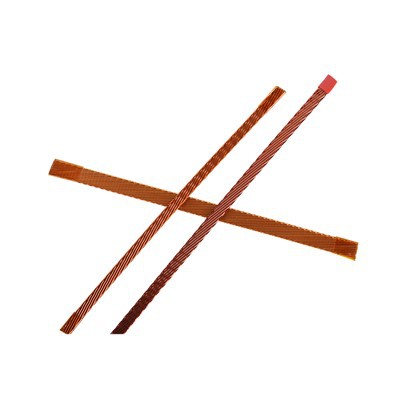
First, let’s start with strand insulation – the backbone of flat Litz wire’s safety, and where most issues originate. Each fine strand is wrapped in a thin layer of enamel, polyimide, or fiberglass, designed to prevent current leakage between strands, which would turn the wire into a single high-resistance conductor. If that insulation is scratched, nicked, or degraded during manufacturing, cutting, or installation, you’re looking at hot spots that can lead to insulation breakdown, arcing, or even fire. Last year, a customer in the aerospace sector called me in a panic: their prototype inverter was failing safety tests after just 48 hours of operation. After we analyzed their installed wire, we found half a dozen micro-scratches along flat edges where the insulation had rubbed against the mounting bracket’s sharp corners during assembly. Those scratches let strands touch, creating a localized hot spot that exceeded the insulation’s temperature rating, melting it, and creating a short circuit.
As a supplier, we flag this upfront in our product datasheets, but I can’t stress enough how important it is to treat flat Litz wire’s strand insulation like fine silk – not heavy-duty cable jacket. Unlike round wire, where insulation sits uniformly around the conductor, flat Litz’s strands are stacked in layers, so the top and bottom strands are more exposed to friction. Even a small nick in a single strand can spiral: if adjacent strands touch, they form a tiny local circuit that generates extra heat, which degrades surrounding insulation, leading to more short circuits, and eventually, a failure. The fix here is twofold: first, when handling flat Litz wire, use tools with rounded edges, and avoid pulling it over sharp brackets or edges without a protective grommet. Second, specify a strand insulation with a temperature rating at least 20% higher than your application’s maximum operating temperature. For example, if your inverter runs at 105°C, don’t use standard 130°C-rated enamel – go for 155°C polyimide to build a buffer.
Next, flat profile-specific insulation and mechanical protection. Here’s another quirk of flat Litz wire: its wide, thin shape means it has much less structural rigidity than round wire of the same cross-sectional area. That makes it way more prone to bending kinks, pinching, or stretching during installation – and those deformations don’t just ruin electrical performance; they cause safety hazards. A kink in a flat Litz bend can squeeze strands together, damaging their insulation or even breaking fine conductors. I saw this with a wind turbine customer who tried to route 100-square-millimeter flat Litz wire through a tight 90-degree bend on their generator. They bent it around a metal frame without a bending tool, and the kink compressed the strands, creating internal strand-to-strand shorts that only showed up during full load testing. The result was a partial discharge that corroded nearby components, requiring a $40,000 repair and a 2-week turbine shutdown.
For this, as a supplier, we always recommend specifying a flexible outer jacket for flat Litz wire when installation involves tight bends, vibrations, or repeated movement – like in robotics, wind turbines, or electric vehicle powertrains. The jacket doesn’t just add mechanical strength; it acts as a barrier against abrasion from surrounding components. Another critical point: avoid bending flat Litz wire beyond its minimum bend radius. Unlike round wire, where minimum bend radius is typically 3 to 5 times the diameter, flat Litz’s minimum bend radius is 8 to 12 times its thickness to prevent strand compression. I often see customers make the mistake of using the same bend radius as round wire, and that’s where safety issues start. If you’re working with a flat Litz wire that’s 3mm thick, your bend radius shouldn’t be less than 24mm – any smaller, and you risk crushing the strand stack, damaging insulation, and creating short circuits.
Then there’s thermal management – a topic that’s tied directly to safety, because excess heat is the number one cause of electrical component failures, and flat Litz’s unique design means it generates heat differently than round wire. The flat profile is supposed to dissipate heat faster due to larger surface area, but only if that heat can escape evenly. If the wire is mounted flush against a metal surface with no thermal interface material, or if the flat sides are pressed tight against each other in a bundle, the heat gets trapped. That creates hot spots that are 15 to 20°C higher than the average wire temperature, which can degrade insulation over time.
A customer in the power transformer industry learned this the hard way. They installed flat Litz wire in a compact transformer, stacking 12 layers of wire directly against each other without any spacing or thermal pads. During operation, the trapped heat caused the strand insulation in the inner layers to break down over 18 months, leading to a short circuit that destroyed the transformer. That’s a preventable issue, and as a supplier, we work with customers to calculate the required spacing based on their application. For enclosed spaces, we recommend using thermal gap fillers between flat Litz layers to move heat away from the wire, and ensuring that at least one side of each wire is exposed to cooling airflow. For power applications above 500 amps, we also offer flat Litz with a slightly increased thickness (or “thick flat Litz”) that has a larger cross-sectional area, reducing current density and thus heat generation in the first place.
Another safety factor that’s often overlooked: EMI and induced currents. Flat Litz wire’s design, while perfect for reducing skin effect, can make it more susceptible to external electromagnetic interference (EMI) if not installed correctly, and it can also induce currents in nearby metal components – a hazard that’s especially risky in high-voltage applications like EVs or data centers. Because flat Litz is laid out in a flat, wide profile, the magnetic fields from the current running through it are distributed over a larger area, which can induce eddy currents in adjacent metal brackets, chassis, or other wires. Those eddy currents generate extra heat, and in some cases, can create enough voltage to cause arcing between the wire and the metal bracket.
Last year, a customer in the EV industry called about repeated arcing in their battery pack’s busbars. We traced the issue to their flat Litz busbar being mounted directly against a steel chassis. The current through the Litz was inducing eddy currents in the steel, which heated the bracket enough to melt a small gap in the bracket’s paint, leading to arcing between the busbar and chassis. The fix here was simple: add a non-conductive, high-temperature insulation spacer between the flat Litz wire and the metal bracket, and also route the flat Litz away from other high-current components in the same plane. For critical applications like EVs or aerospace, we also offer shielded flat Litz wire, which has a thin copper or aluminum braid wrapped around the outer jacket to block external EMI and prevent induced currents in nearby components. That shield doesn’t just improve electrical performance – it adds a layer of safety by eliminating arcing risks.
I also need to touch on voltage rating, which is a make-or-break safety point for flat Litz wire. Because it’s made of many fine strands, the voltage between individual strands is low, but the overall voltage rating of the wire depends on the insulation’s thickness. Many customers assume that a flat Litz wire with a higher strand count is automatically safer for high-voltage applications, but that’s not the case if the outer jacket or strand insulation is underrated. For example, a 10-strand flat Litz wire with 500V-rated enamel insulation might be rated for 1000V between layers, but if you’re using it in a 1500V electric vehicle, that insulation will break down over time, leading to a flashover.
As a supplier, we always provide voltage testing data for our flat Litz wires, including the dielectric strength (how much voltage the insulation can withstand without breaking down). I recommend always testing the wire’s dielectric strength at 1.5 times your application’s maximum operating voltage during installation and after any maintenance. This simple step can catch micro-scratches or insulation damage that would otherwise cause a failure. For high-voltage applications (above 1000V), we offer a double-insulated flat Litz wire, which adds an extra layer of cross-linked polyethylene (XLPE) around the outer jacket for additional dielectric protection.
Wait, let’s not forget about installation-specific safety. Flat Litz wire is flat, so when routing it, it’s easy to route it in a way that creates a sharp edge between the flat sides. If you’re securing the wire with zip ties or brackets, don’t tighten them so much that they pinch the flat edges – that can damage the strands and insulation. I’ve had customers send back flat Litz wire with visible indentations from over-tightened zip ties, and every time, those indentations were the cause of insulation failure in the field. The rule of thumb here is: use wide, flat clamps or grommets when securing flat Litz wire, and tighten just enough to hold it in place – no more.
Now, you might be wondering: why work with flat Litz at all if there are so many safety considerations? The answer is that when installed correctly, it’s one of the safest, most efficient conductors for high-frequency, high-current applications. But those safety considerations aren’t just tips – they’re non-negotiable to avoid failure, downtime, or even safety hazards. Over the years, I’ve seen customers save thousands of dollars by taking the time to choose the right insulation, bend radius, and thermal management, and I’ve seen others lose entire projects due to skipping these steps.
If you’re working on a project that uses flat Litz wire, or you’re considering switching from round wire, I’m here to help. We’ve supplied flat Litz wire to industries ranging from aerospace to renewable energy, and we work with you at every step: from selecting the right strand insulation and jacket, to calculating bend radii and thermal needs, to providing testing data to meet your safety standards. Don’t take chances with your wire’s safety – reach out to our team of engineers to discuss your requirements and get a custom recommendation tailored to your application.
Enamel Wire References
- Electrical Safety Foundation International (ESFI). (2022). Electrical Safety for Conductors and Wiring Systems. Arlington, VA: ESFI.
- National Electrical Manufacturers Association (NEMA). (2021). Standard for Flat Litz Wire Performance and Safety. Rosslyn, VA: NEMA.
- International Electrotechnical Commission (IEC). (2020). IEC 60317-13: Specifications for Special Winding Wires – Part 13: Polyimide-Enamelled Round Copper Wire. Geneva, Switzerland: IEC.
- Institute of Electrical and Electronics Engineers (IEEE). (2019). IEEE Standard for Safety in Nuclear Power Generating Stations (Including Electrical Wiring). Piscataway, NJ: IEEE.
- Society of Automotive Engineers (SAE). (2021). SAE J1128: Low-Voltage Primary Electrical Cable for Automotive and Engine Equipment. Warrendale, PA: SAE International.
Tianjin Jingwei Power Technology Co., Ltd.
As one of the most professional flat litz wire manufacturers and suppliers in China, we’re featured by quality products and good service. Please rest assured to buy durable flat litz wire made in China here from our factory. Contact us for more details.
Address: No.1 Chuangxin Rd. Xiaozhan Industrial Park, Jinnan District, Tianjin, China
E-mail: info@jwdc.cn
WebSite: https://www.jw-dcs.com/
