If you’ve ever worked on overhead power lines, communication towers, or even that sturdy utility pole on the corner of your street, you’ve probably heard the terms “strain insulator” and “anchor insulator” thrown around. At our company, as a strain insulator supplier, I get calls all the time from folks who mix these two up—and honestly, that confusion can lead to some big headaches (and not just for their budget). Let’s break down what sets them apart, why it matters, and how getting the right one makes all the difference in keeping infrastructure safe. Strain Insulator
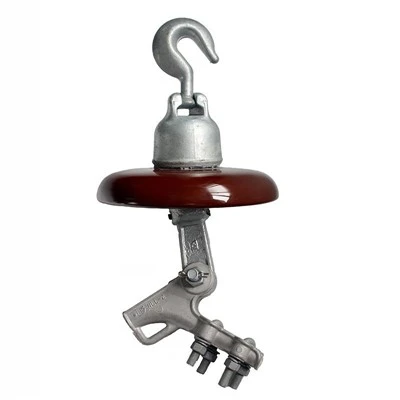
First, let’s start with the basics: every overhead line needs to handle two main types of stress. There’s tension—the pulling force from the weight of the wire itself, wind, ice, or even temperature changes that make wires expand and contract. Then there’s compression or the side-to-side force from structures pulling against each other. Insulators, broadly speaking, are the non-conductive parts that keep electricity from leaking into metal poles or the ground, but each type is built to handle one specific type of load, which is where strain and anchor insulators come in.
Let’s talk about strain insulators first, since that’s what we specialize in here. A strain insulator is designed specifically to bear tension. That’s not a throwaway detail—if you look at where power lines turn a corner, or where two line segments meet at a “dead end” (a spot where a line stops short and is secured to a pole), those are the spots you’ll find strain insulators. They work by being stretched between two conductors or between a conductor and a support structure. Their structure is built to distribute pulling force across multiple small, insulated discs (usually made of porcelain, glass, or polymer composite) stacked together. Each disc acts as a barrier, so even if one gets scratched or damaged, the others keep the current from grounding out.
I remember a project a couple years back where a small rural utility company called us in a panic. They had strung a new fiber optic line across a valley and used a generic insulator for the dead end—what they thought was an anchor insulator, but it was actually a lightweight distribution insulator meant for low tension. Within six months, a heavy ice storm hit, and the line pulled so hard the insulator cracked, sending a section of line crashing into a pasture. No one was hurt, but the repair cost them way more than if they’d used a proper strain insulator. That’s why for high-tension applications—like long-span lines, corner poles, dead ends, or where wires have to change direction—strain insulators are non-negotiable. They’re rated for the maximum tensile load the line will experience, so they don’t just insulate, they actively hold the line in place while doing that job.
Now, anchor insulators. This is where the confusion happens, because at first glance, they look similar. But anchor insulators are designed to handle compressive or side loads, not tension. They get their name because they’re used in “anchoring” applications—think of guy wires that hold a utility pole upright. Guy wires are thick, heavy cables attached to the top of a pole, strung at a 45-degree angle to an anchor in the ground. If the pole leans, the guy wire pulls it back. But without an insulator in that guy wire, electricity from the line could travel down the guy wire to the ground, or lightning could strike the guy wire and fry the pole’s electrical components. That’s where the anchor insulator comes in: it’s placed in the guy wire to keep the conductive guy wire from grounding out, but it’s built to withstand the side-to-side or compressive force of the guy wire, not the tension of a running power line.
Wait, let’s make that difference even clearer. If you hang a power line between two poles, the strain insulator is holding the line’s tension (pulling apart) while insulating the line from the pole. If you attach a guy wire to that same pole, the anchor insulator is sitting in the guy wire, which is pulling sideways (toward the ground anchor) to keep the pole stable. You can’t swap these two, and here’s a key test: if the load is pulling the insulator along its axis (straight), that’s strain. If the load is pushing or pulling perpendicular to the insulator’s axis, that’s anchor.
Another big difference is construction. Strain insulators are almost always made of multiple small discs connected end-to-end (this is called a “string”). The number of discs depends on the voltage of the line: a 110kV line might need 7-9 discs, while a 500kV line needs 20 or more. These stacked discs spread out the tensile force, so no single disc takes all the stress. Anchor insulators, on the other hand, are often one solid piece or a shorter stack of discs, built to handle the shear or side load of guy wires. They might also have different fittings on the ends to attach to the thick, heavy cables used for guy wires, rather than the thinner conductors used in power lines.
I’ve seen too many projects cut corners here. One customer tried to use our strain insulators in a guy wire application because they were cheaper, but the first high wind made the insulator crack from the side load. The pole leaned six inches in a week before they replaced it with proper anchor insulators. The cost of fixing that lean was way more than the difference in insulator prices. That’s why matching the insulator to the load is critical.
What about other use cases? Strain insulators are also used in suspension insulators? No, wait—suspension insulators are a type of strain insulator, actually. They’re the ones used where a line hangs from a pole, so the insulator is supporting the line’s weight (tension) while keeping it separated. Anchor insulators are less common in high-voltage line applications, more for distribution poles, communication towers, and guyed structures.
Let’s talk about material, too, because that plays into their purpose. Our strain insulators are available in porcelain, glass, and polymer composite. Polymer strain insulators are especially popular now because they’re lightweight, resist ice and corrosion, and are easier to install in hard-to-reach places. Anchor insulators might also use these materials, but their design prioritizes side load strength over tensile capacity. A polymer anchor insulator isn’t rated for the same pulling force as a polymer strain insulator—if you put a 10,000lb tensile load on an anchor insulator, it will break.
Here’s a common myth: some people think all insulators do the same thing, just in different spots. But no—their load rating is the foundation of their function. Insulation is the core job, but the structural load capacity determines where they can be used. A strain insulator’s insulation is designed to work while being stretched, while an anchor insulator’s insulation is designed to work while being pushed or pulled sideways.
Why does this matter for you? If you’re a utility company, a tower builder, a renewable energy installer (solar farms have lots of overhead lines, right?), or even someone doing a DIY telecom project, using the wrong insulator is a safety hazard. Faulty insulators can cause power outages, electrical fires, structural damage, or even injury. That’s why at our company, as a strain insulator supplier, we don’t just sell parts—we help our customers figure out exactly what they need based on line voltage, tension load, and application. We’ve worked on projects ranging from small residential telecom lines to 765kV transmission lines, and we always start by asking: is this a tension application, or a side-load application? That question tells us if they need a strain or an anchor insulator.
Let’s wrap this up to make the key takeaways clear. First, strain insulators handle tensile (pulling) loads—they’re used for line turns, dead ends, and long spans, and their stacked-disc construction is built to withstand straight pulling force. Anchor insulators handle side or compressive loads—they’re used in guy wires for poles and towers, and their design prioritizes resisting sideways force. Second, you can’t swap them. Using a strain insulator for a guy wire’s anchor point will cause cracking or failure from side load. Using an anchor insulator for a high-tension line will break under the line’s weight and tension. Third, always match the insulator’s rating to your specific application. That’s not just a recommendation—it’s a rule for safe, reliable infrastructure.

If you’re working on a project and you’re not sure which insulator you need, or you’re looking for high-quality, tested strain insulators for your next transmission or distribution line build, our team is here to help. We’ve been supplying insulators to infrastructure projects across the region for years, and we know how important it is to get every part right. Don’t risk safety or downtime by guessing—reach out to our team to discuss your project requirements, and we’ll help you find the perfect solution.
Suspension Insulator References
- Electrical Insulators: Types, Construction, and Applications. IEEE Power & Energy Society, 2021.
- Overhead Line Design and Construction: A Practical Guide. International Council on Large Electric Systems (CIGRE), 2019.
- Utility Pole Anchoring and Insulation Standards. National Association of State Utility Consumer Advocates (NASUCA), 2022.
- Strain Insulator Performance Under Tensile Loads. Journal of Electrical Materials and Power Systems, Vol. 15, No. 2, 2020.
Pingxiang Star Electric Porcelain & Insulator Co., Ltd.
We are one of the most professional strain insulator manufacturers and suppliers in China, also support customized service. We warmly welcome you to buy bulk high quality strain insulator in stock here from our factory. If you have any enquiry about pricelist, please feel free to email us.
Address: Wuli Village, Xiangdong Town, Xiangdong District, Pingxiang City, Jiangxi Province, China
E-mail: star_insulator@sina.com
WebSite: https://www.star-insulators.com/
